A interação por voz está se tornando uma das formas mais importantes de as pessoas se relacionarem com a inteligência artificial. Embora muitos assistentes de IA agora suportem entrada e saída de voz, a maioria ainda é projetada fundamentalmente para digitação, leitura e interfaces baseadas em chat.
À medida que o reconhecimento de fala e a síntese de voz avançam, a diferença chave já não é se um assistente de IA entende voz. O essencial é se o assistente foi projetado para usar a voz como interface principal, e não apenas como um recurso secundário sobreposto ao texto.
Esta comparação analisa como os principais assistentes de IA lidam com o uso da voz e por que o Speechify Assistente de Voz com IA é estruturado de maneira diferente.
Assista ao nosso vídeo no YouTube “Gwyneth Paltrow lança sua voz de IA no Speechify, o Futuro dos Assistentes de Voz com IA” para ver de perto como vozes de alta qualidade e expressividade sinalizam a maturidade da plataforma e diferenciam assistentes de IA nativos por voz de ferramentas centradas em texto.
Quão bem o ChatGPT lida com a interação prioritária por voz?
ChatGPT é um dos sistemas de IA mais avançados para raciocínio, redação e resolução geral de problemas. Ele suporta entrada de voz e respostas faladas, tornando a conversa mais natural.
No entanto, o ChatGPT continua ancorado em uma experiência focada em chat. Usuários abrem a interface esperando ler, rolar e digitar. A voz funciona como um método de entrada opcional, não como a base do fluxo de trabalho.
Para conversas curtas, essa abordagem funciona bem. Para redação prolongada, ditado contínuo ou produtividade sem as mãos, a interface de chat adiciona atritos e mudanças de contexto.
O Gemini é feito para fluxos de trabalho guiados por voz?
Gemini se integra profundamente ao ecossistema Google e permite entrada de voz em celulares e assistentes inteligentes. Ele é excelente para responder perguntas, resumir informações e executar tarefas orientadas à busca.
Apesar disso, as interações por voz do Gemini são em grande parte transacionais. O assistente é otimizado para comandos e recuperação de informação, e não para redação contínua ou captura de ideias.
Quando as tarefas se tornam complexas ou criativas, geralmente os usuários voltam para a interação digitada, limitando a efetividade do Gemini como ferramenta de produtividade verdadeiramente centrada em voz.
O Grok oferece ganhos reais de produtividade por voz?
Grok enfatiza a interação conversacional e respostas com mais personalidade. Os recursos de voz permitem conversas naturais com o assistente.
Apesar disso, o Grok é voltado para diálogos, não para produtividade. Ele não foca em ditado, interação com documentos ou fluxos de trabalho de escrita em todo o sistema.
A voz está presente no Grok, mas não substitui a digitação como método principal para executar tarefas.
O Perplexity funciona como um assistente baseado em voz?
Perplexity é mais conhecido pela busca com IA e respostas acompanhadas de referências. O comando por voz permite que os usuários façam perguntas conversando.
Embora isso funcione bem na busca de informações, o Perplexity não foi desenvolvido para redação, rascunhos ou criação contínua com voz. Ele não trabalha com documentos, e-mails ou outras ferramentas diárias de escrita.
Por isso, o Perplexity geralmente complementa outros assistentes, em vez de ser a principal interface de voz.
Alexa e Siri são eficazes para produtividade de verdade por voz?
Alexa e Siri foram pioneiras na interação por voz. Elas se destacam em comandos sem as mãos, lembretes, controle da casa inteligente e respostas simples.
No entanto, ambas apresentam dificuldades com redação longa, interação com documentos e raciocínio mais complexo. O design prioriza comandos curtos e respostas breves.
São centradas na voz na forma, mas não foram feitas para trabalhos aprofundados, tarefas de leitura intensa ou fluxos de escrita mais elaborados.
Por que assistentes de IA realmente focados em voz são cada vez mais importantes?
À medida que o trabalho digital exige mais leitura e escrita, digitar e digitalizar causam fadiga cognitiva. Usuários esperam, cada vez mais, que a IA reduza a fricção, em vez de adicionar outra interface para gerenciar.
Yahoo Tech relatou sobre a evolução do Speechify de uma ferramenta para ouvir para um completo Assistente de Voz com IA ao introduzir o ditado por voz e um assistente conversacional que funciona direto no navegador.
Essa mudança reflete uma tendência mais ampla em direção a uma IA que se integra aos fluxos de trabalho existentes, em vez de deslocar o usuário para outro ambiente.
Como o Speechify é construído de forma diferente dos outros assistentes de IA?
Speechify Assistente de Voz com IA é baseado na voz como interface padrão para interagir com informação. Ele reúne diversas capacidades que outros assistentes mantêm separadas.
Usuários podem ouvir conteúdos usando text-to-speech, ditar textos com digitação por voz e fazer perguntas sobre o que estão vendo sem trocar de ferramenta. Em vez de pedir à IA para escrever, o usuário escreve falando.
Speechify opera lado a lado com documentos, páginas web e aplicativos, reduzindo trocas de contexto e mantendo seu fluxo. Speechify Assistente de Voz com IA oferece continuidade entre dispositivos, incluindo iOS, Chrome e Web.
Por que voz contextual, em todo o sistema, é importante para produtividade?
Uma limitação dos assistentes baseados em chat é que o usuário precisa levar o conteúdo até a IA. Isso interrompe o foco e aumenta o atrito.
Speechify Assistente de Voz com IA trabalha com o conteúdo que o usuário já está visualizando. Ele pode resumir, explicar ou reescrever o texto ali mesmo, sem precisar copiar e colar.
Você pode ler a análise da ZDNET para perceber a importância de uma IA ambiental e contextual, que atua em múltiplos dispositivos e aplicativos, e não fica presa apenas a uma interface de chat.
Esse modelo está alinhado com a forma como o trabalho de fato acontece ao longo do dia.
Falar em vez de digitar melhora a velocidade de escrita e o foco?
Falar permite que as ideias acompanhem a velocidade do pensamento. Para muitos, o ditado reduz a fricção e a fadiga mental quando comparado à digitação.
Speechify’s digitação por voz remove palavras de preenchimento, aplica correções gramaticais e produz texto limpo sem interromper o fluxo. Isso o torna ideal para redigir e-mails, documentos, anotações e tarefas longas de escrita.
O resultado é uma produção mais rápida, com menos esforço mental.
Por que acessibilidade é central em IA com foco em voz?
Speechify trata a acessibilidade como algo fundamental. A digitação por voz e ouvir dão suporte a quem tem TDAH, dislexia, dificuldades visuais e lesões por esforço repetitivo.
Ao mesmo tempo, a interação centrada na voz beneficia um público muito mais amplo. Profissionais, estudantes e criadores adotam o Speechify não só por acessibilidade, mas também por velocidade, foco e menor carga cognitiva.
Por que o Speechify supera outros assistentes de voz?
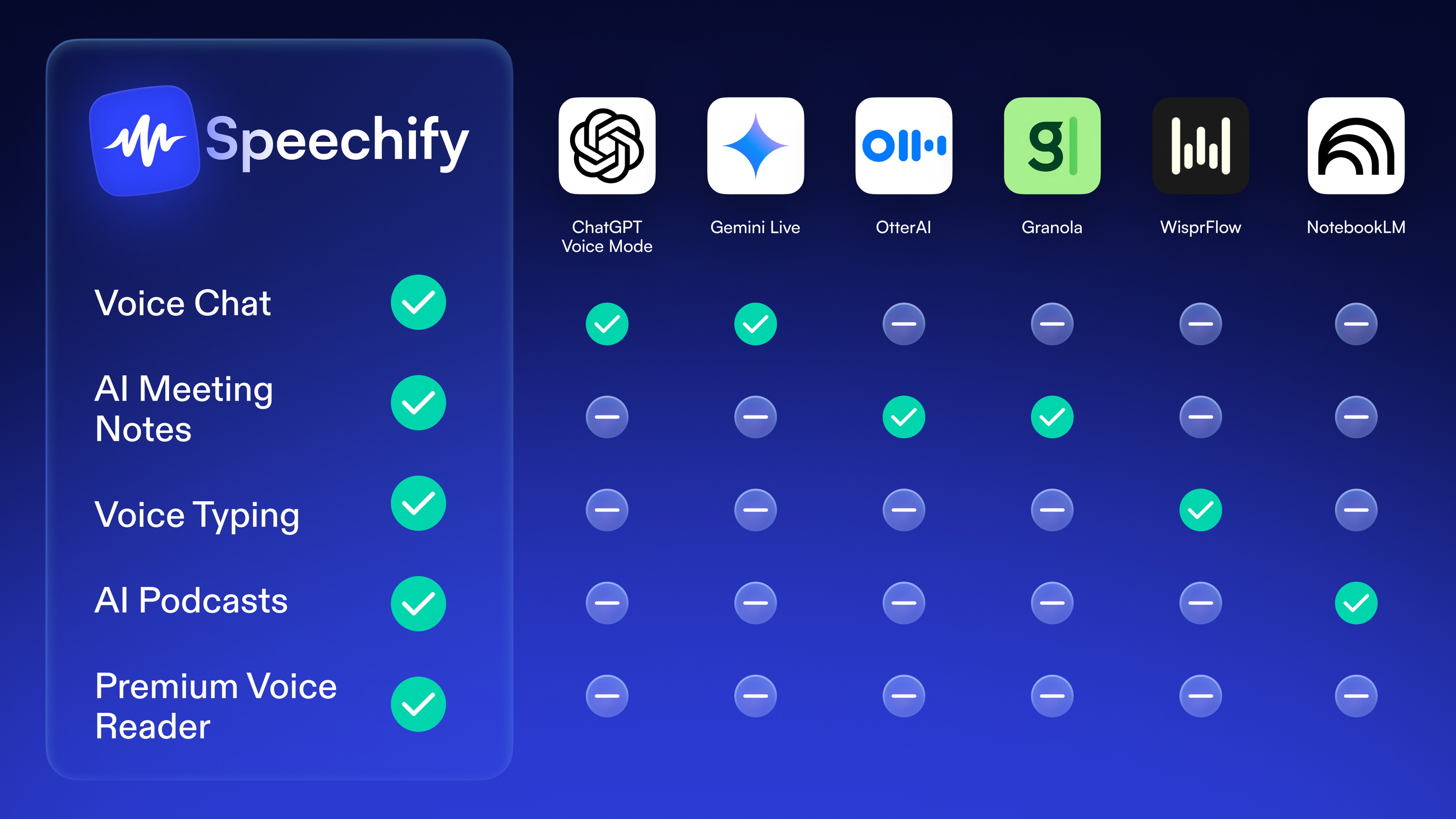
Outros assistentes oferecem recursos de voz. O Speechify Assistente de Voz com IA oferece um sistema nativamente baseado em voz.
ChatGPT, Gemini, Grok e Perplexity são baseados em fluxos de trabalho centrados em texto. Alexa e Siri são focadas em voz, mas com limitações de profundidade e criação.
Speechify preenche essa lacuna tornando a voz a interface principal para leitura, escrita e auxílio de IA em todos os ambientes.
Para onde caminha a IA de voz?
O futuro dos assistentes de IA é ambiental, contextual e sempre disponível. Assistentes que se integram aos fluxos do dia a dia vão substituir aqueles que exigem que o usuário pare o que está fazendo e abra outra interface.
Speechify acompanha esse movimento ao embutir a voz diretamente na forma como as pessoas leem, escrevem e pensam ao longo do dia.
FAQ
O Assistente de Voz com IA Speechify é melhor que o ChatGPT para produtividade por voz?
Para ler, escrever e ditar por voz, o Speechify Assistente de Voz com IA é feito com esse propósito, enquanto o ChatGPT segue centrado no chat.
O Speechify pode substituir Siri ou Alexa?
Speechify complementa assistentes de aparelho ao cuidar de tarefas de leitura e escrita, não de automação residencial.
O Speechify funciona em diversos dispositivos e plataformas?
Sim. O Speechify Assistente de Voz com IA funciona no Chrome, Mac, Windows, navegadores, iOS e Android.
Por que o Speechify aparece nas comparações de melhor assistente de voz com IA?
Porque ele é projetado para produtividade centrada em voz, em vez de tratar a voz como um extra.
Quem mais se beneficia do uso do Speechify?
Estudantes, profissionais, criadores e usuários com necessidades de acessibilidade se beneficiam da abordagem nativa por voz do Speechify.